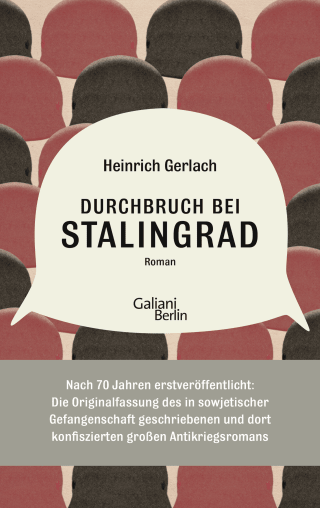
The original version of the great antiwar novel, confiscated by the Russian secret services in 1949, now rediscovered in the Russian archives
This book has one of the most unusual publishing histories ever: Heinrich Gerlach, gravely injured as a German officer in the Battle of Stalingrad, began writing a novel while in Soviet captivity that was meant to starkly convey the horror of Stalingrad, the pointlessness of the war, and above all the spiritual transformation of a German soldier under the influence of his experiences. In 1943, Gerlach became a founding member of the Bund Deutscher Offiziere (League of German Officers), which called for an end to the senseless war from a position of captivity. Gerlach managed to keep his manuscript safe even in the labor camps. In 1949, however, the Russian secret services discovered and confiscated the 600-page novel. Gerlach only made it back to Germany in the spring of 1950 – but without the novel. All his attempts to reconstruct it from memory failed – until Gerlach came up with an unusual idea. Under hypnosis, he was able to remember parts of the book. In 1957, over a decade after he was taken prisoner, the book was published under the title Die verratene Armee (“The Forsaken Army: The Great Novel of Stalingrad”). It sold millions of copies.
Now, Carsten Gansel has made a sensational find in Moscow’s archives: the original manuscript of Gerlach’s Durchbruch bei Stalingrad (“Breakthrough at Stalingrad”), which differs sharply from the previously published version. With a rich documentary annex provided by the editor, it is now available in published form for the first time, 70 years later.